

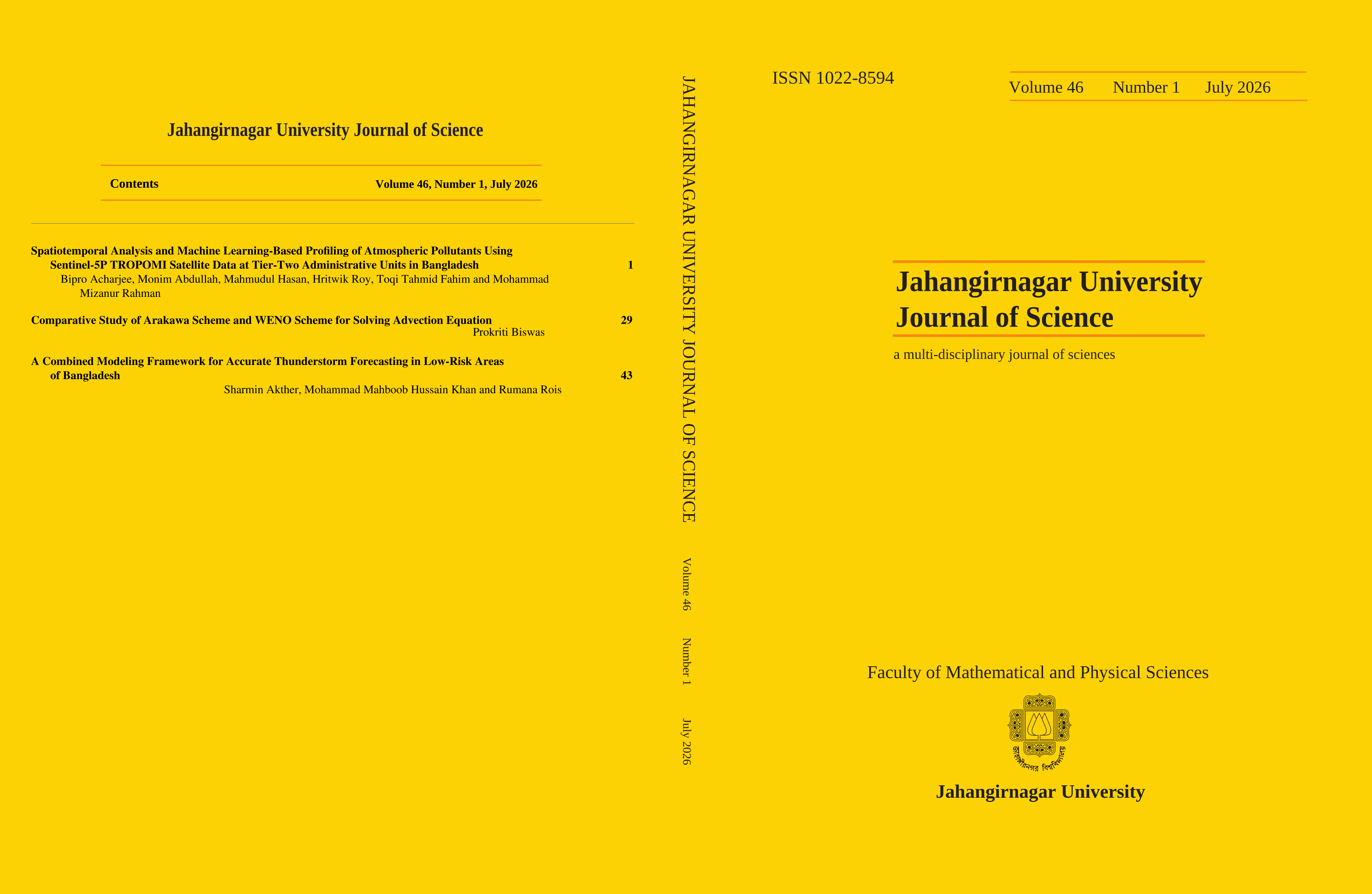
Combination Models for Accurate Thunderstorm Forecasting in Bangladesh's Low-Risk Zone
Thunderstorm Forecasting in Bangladesh's Low-Risk Zone
Keywords:
Machine Learning Algorithms, Deep learningAbstract
Thunderstorms can devastate buildings, crops and human life even in "low risk" areas like Sitakunda, Bangladesh. This conundrum underscores the need for timely and accurate forecasting to safeguard vulnerable, resource-poor populations. But traditional models often struggle to account for the nonlinear and seasonality of thunderstorms, and little research has been done on predicting the daily occurrence of thunderstorms in low-risk regions. This research seeks to enhance thunderstorm frequency forecasting by extensively evaluating and comparing statistical, machine learning, and deep learning approaches (ETS, ARIMA, STL-ETS, STL-ARIMA, NNAR, TBATS, Prophet, GARCH, SVM, and LSTM). An innovatively combined model is also developed. Applying daily thunderstorm counts from Sitakunda (1981-2023) and measuring performance using RMSE and MAE, the findings show the combination model achieves the lowest prediction errors and most reliable forecasts. Although Prophet and SVM show comparable results, GARCH has the lowest RMSE (1.3137). By contrast, LSTM and NNAR exhibit larger errors, suggesting that they struggle to model the unpredictable nature of thunderstorms. These results demonstrate the benefits of combination forecasting in improving thunderstorm predictions for low-risk areas. Incorporation of these models into early warning systems and local governance can enhance preparedness, minimize disruptions and injuries, and foster resilience to thunderstorm risks in the long term.
Downloads
Published
How to Cite
Issue
Section
License
Copyright (c) 2026 Jahangirnagar University Journal of Science

This work is licensed under a Creative Commons Attribution-ShareAlike 4.0 International License.
©2026Jahangirnagar University Journal of Science. All rights reserved. However, permission is granted to quote from any article of the journal, to photocopy any part or full of an article for educational and/or research purposes to individuals, institutions, and libraries with an appropriate citation in the reference and/or customary acknowledgment of the journal.